

Rethinking the Entire User Journey
Most people associate User Experience with websites and mobile apps.
Tesla proved that UX can extend far beyond digital interfaces.
The vehicle isn't the product.
The entire journey is.
Every interaction between the owner and the vehicle has been intentionally designed to reduce friction and increase confidence.
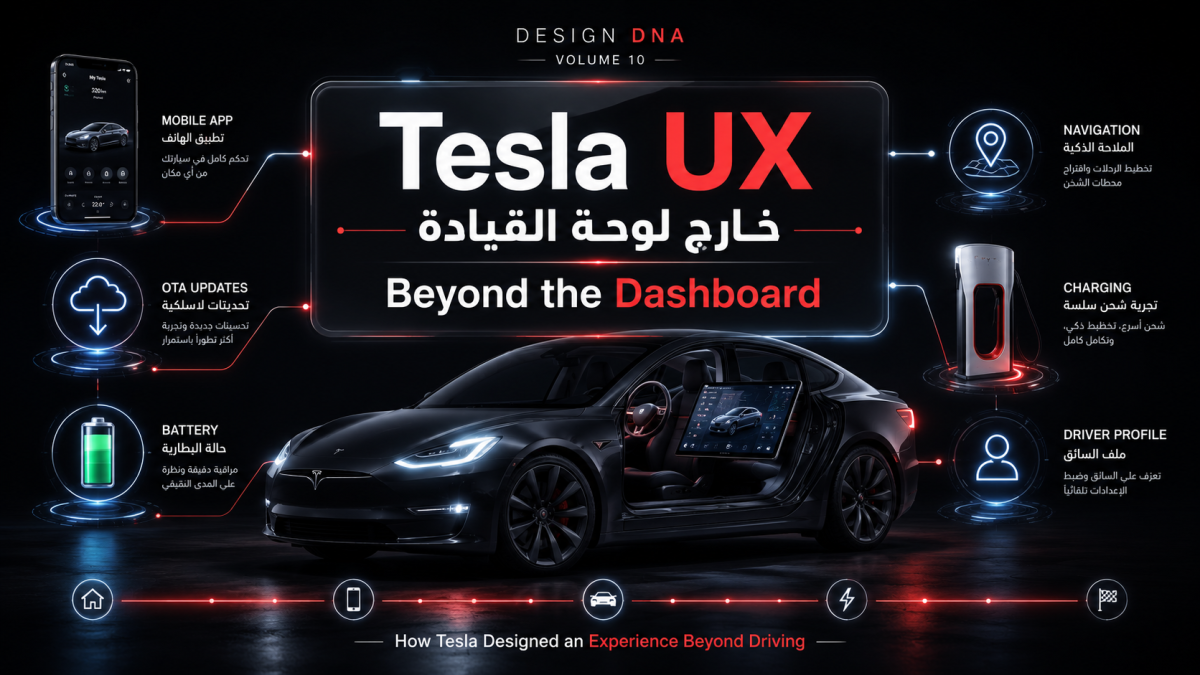
1. The Experience Begins in the App
For most car manufacturers, the mobile app is an accessory.
For Tesla, it's the starting point.
Users can:
- Lock and unlock the vehicle
- Pre-condition the cabin
- Monitor battery status
- Track charging progress
- Locate the vehicle
- Summon the car on supported models
Your smartphone becomes the primary key to the entire experience.
2. Fewer Buttons, Better Decisions
Tesla challenged decades of automotive design by removing most physical controls.
Instead of dozens of buttons scattered across the dashboard, nearly everything is managed through a unified digital interface.
This approach delivers:
- Less complexity
- Greater consistency
- Easier software updates
- Cleaner interactions
Minimalism isn't about removing features.
It's about removing unnecessary decisions.
3. A Car That Improves Over Time
Traditional vehicles improve when you buy the next model.
Tesla improves while sitting in your garage.
Over-the-air software updates continuously introduce:
- New features
- Performance improvements
- Security enhancements
- Bug fixes
Without visiting a service center.
This fundamentally changes what ownership means.
4. Charging Without Anxiety
Range anxiety has always been one of the biggest barriers to EV adoption.
Tesla redesigned the charging experience by integrating it into the journey.
Navigation automatically:
- Suggests charging stops
- Estimates arrival battery percentage
- Calculates charging duration
- Optimizes long-distance routes
Instead of managing charging...
Drivers simply focus on driving.
5. The Car Knows You
The moment you enter the vehicle, it recognizes who you are.
Automatically adjusting:
- Seat position
- Mirrors
- Steering wheel
- Climate control
- Driving preferences
- Media settings
No setup.
No repetition.
Just continuity.
6. Simplicity Is Not Emptiness
Many people describe Tesla interiors as minimal.
In reality, every removed element represents a deliberate design decision.
Nothing exists without purpose.
Everything contributes to clarity.
7. A Vehicle That Behaves Like Software
Tesla no longer treats a car as a finished product.
Instead, it behaves like a software platform that evolves continuously.
New updates can introduce:
- Better driving assistance
- Improved interfaces
- Entertainment features
- Safety enhancements
- Performance upgrades
The vehicle becomes a living product rather than a static machine.
What UX Designers Can Learn?
Don't design individual screens.
Design complete experiences.
Think beyond the interface.
Every touchpoint shapes the user's perception.
Great UX starts before interaction and continues long after it ends.
Conclusion
Tesla's competitive advantage isn't just electric motors or batteries.
Its real innovation lies in treating every interaction as part of one connected experience.
The dashboard is only one screen.
The true interface is the entire ownership journey.
The best user experience doesn't live inside the dashboard—it lives throughout the entire journey.